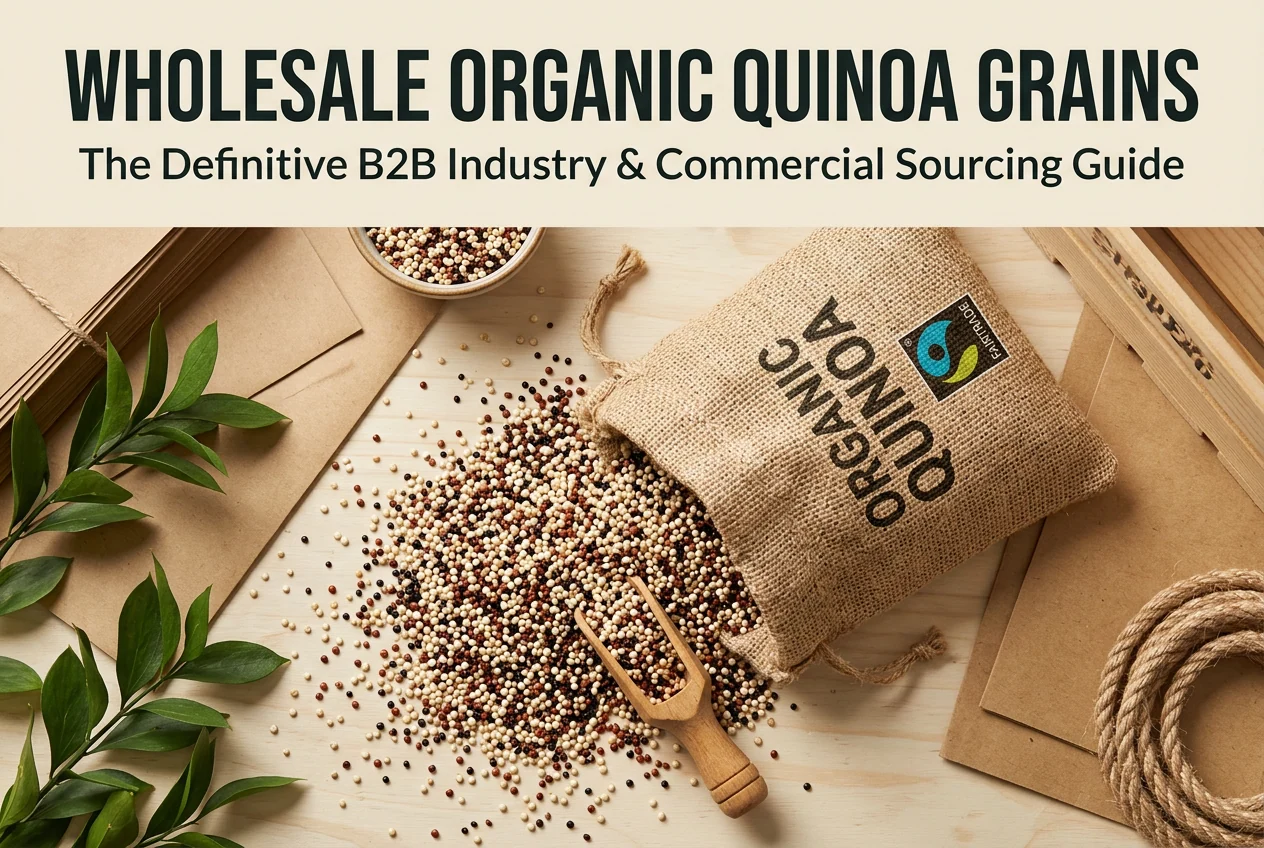
In the rapidly expanding global functional food, plant-based nutrition, gluten-free food manufacturing, and retail packaging sectors, Wholesale Organic Quinoa Grains (Chenopodium quinoa) represent one of the most commercially critical pseudo-cereal raw materials. Native to the high-altitude Andean altiplano of South America—where it has been cultivated for over 5,000 years—quinoa is globally recognized for its exceptional nutritional matrix, offering a complete plant-based protein spectrum containing all nine essential amino acids alongside rich dietary fiber, minerals, and bioactive polyphenols.
For commercial food manufacturers, private-label brand developers, industrial bakeries, and wholesale procurement managers, organic quinoa grains provide unparalleled formulation versatility. Whether utilized as raw whole grains, flaked for breakfast cereals, milled into gluten-free functional flours, or processed into ready-to-eat grain bowls, quinoa meets the growing worldwide demand for clean-label, non-GMO, and allergen-free ingredients.
However, commercial procurement leads and quality control directors face distinct technical challenges when sourcing bulk quinoa: controlling bitter saponin residue through mechanical vs. wet processing, verifying strict low-moisture standards to prevent grain mold, managing heavy metal and pesticide compliance, and ensuring batch-to-batch physical purity and color consistency.
This technical buyer’s guide delivers an exhaustive analysis of wholesale organic quinoa grain procurement—evaluating Andean agricultural harvesting standards, saponin extraction mechanics, biochemical amino acid profiles, COA auditing criteria, and commercial formulation guidelines.
1. Agricultural Terroir & Saponin Processing Mechanics: The Quality Benchmark
The functional performance, shelf life, and taste profile of commercial organic quinoa grains are determined long before final packaging—beginning with high-altitude cultivation, harvest timing, and mechanical saponin removal.
                    [ Organic Chenopodium Quinoa Harvest ]
                                     │
                                     ▼
                [ Seed Threshing, Cleaning & Moisture Stabilization ]
                • Moisture stabilized below 11.5% to prevent mold
                                     │
                                     ▼
       ┌─────────────────────────────┴─────────────────────────────┐
       ▼                                                           ▼
[ Mechanical Scarification & Wet Washing ]           [ Unprocessed / High-Saponin Raw Grain ]
• Removes bitter pericarp saponin coating             • Retains bitter saponin layer
• Multi-stage polished & air-dried (<45°C)            • Off-taste & gastrointestinal irritation
• Neutral, clean, nutty flavor profile                 • Unsuitable for direct food manufacturing
The Biological Importance of Saponin Removal
Naturally occurring saponins are bitter triterpenoid glucosides that form a protective outer coating on raw quinoa seeds, shielding the grain from birds and insects during growth. If not properly removed during industrial processing, saponins cause a harsh, soapy taste, inhibit digestion, and interfere with food processing machinery.
-
Mechanical Scarification: Industrial processing begins with mechanical abrasion (scarification), which gently rubs away the brittle outer hull (pericarp) containing the highest concentration of saponins.
-
Controlled Wet Washing & Polishing: Following scarification, the grains undergo rapid wet-washing with clean water to flush out remaining surface saponins, followed by low-temperature air-drying (≤45∘C\le 45^\circ\text{C}) to restore grain moisture to a stable ≤11.5%\le 11.5\%.
-
Purity & Saponin Testing: Commercial B2B quinoa must pass strict residual saponin tests (Afrosimetric or HPLC testing) ensuring residual saponin levels remain below 0.01%0.01\% (≤0.1g/kg\le 0.1\text{g/kg}), delivering a smooth, non-bitter, ready-to-cook grain.
2. Chemical Analysis: Amino Acid Density & Nutritional Specifications
A comprehensive Certificate of Analysis (COA) for wholesale organic quinoa grains must evaluate macro- and micronutrient distributions, moisture limits, purity indices, and physical specifications:
┌────────────────────────────────────────────────────────────────────────┐
│                   THE COMPLETE AMINO ACID PROFILE                      │
├────────────────────────────────────────────────────────────────────────┤
│ • Rare Plant Completeness: Unlike cereal grains (low in lysine) or     │
│   legumes (low in methionine), quinoa delivers a balanced 1.0 PDCAAS   │
│   score with high Lysine (~5.8g/100g protein) and Methionine.          │
│ • Gluten-Free Standard: Naturally 100% gluten-free (<20ppm compliant), │
│   making it a premier base for celiac & gluten-sensitive formulations. │
└────────────────────────────────────────────────────────────────────────┘
For commercial food formulators, private-label packagers, and bulk procurement directors seeking premium-grade Andean grains, review technical specifications at Impact Foods Quinoa Bulk Supply.
For retail lifestyle products, organic consumer superfoods, and health-focused pantry staples, explore the complete selection at Yin Yang Superfoods.
3. Biochemical Profile: Essential Amino Acids, Minerals & Functional Benefits
Quinoa grains hold a unique functional position in plant-based food science due to their exceptional nutritional density and structural versatility.
                  [ Core Quinoa Bioactive Component Analysis ]
                                       │
       ┌───────────────────────────────┼───────────────────────────────┐
       ▼                               ▼                               ▼
[ Complete Protein Spectrum ]     [ Bioavailable Mineral Complex ] [ Polyphenols & Flavonoids ]
  All 9 essential amino acids       High Magnesium, Iron, Zinc &     Quercetin & Kaempferol providing
  supporting muscle & cellular repair Potassium supporting metabolic health natural antioxidant defense
1. Complete Plant Protein Architecture
Most plant proteins are incomplete—grains like wheat and rice lack lysine, while pulses like beans and peas are lower in methionine. Quinoa is one of the rare plant foods that provides a balanced, complete protein profile containing all nine essential amino acids in proportions matching human physiological requirements. This makes it an ideal ingredient for plant-based meal replacements, sports nutrition, and vegetarian food manufacturing.
2. Bioavailable Mineral Density
Whole organic quinoa grains are rich in essential trace minerals:
-
Magnesium (∼200mg/100g\sim 200\text{mg}/100\text{g}): Supports cellular energy (ATP\text{ATP}) production, muscle function, and neuromuscular stability.
-
Iron (∼4.5mg/100g\sim 4.5\text{mg}/100\text{g}): Contributes to normal red blood cell formation and systemic oxygen transport.
-
Zinc & Potassium: Supports immune health, cell division, and cellular electrolyte fluid balance.
3. High Fiber & Low Glycemic Index (GI)
With a low Glycemic Index (GI≈53\text{GI} \approx 53), quinoa digests slowly, providing a gradual release of glucose into the bloodstream. Its rich soluble and insoluble dietary fiber matrix supports gut microbiota diversity, satiety, and healthy blood lipid management.
4. Quality Control & Regulatory Verification in Bulk Procurement
Because quinoa is grown in high-altitude agricultural environments, commercial procurement teams must enforce rigorous analytical testing covering heavy metals, mycotoxins, pesticide residues, and physical purity.
                                [ B2B VENDOR AUDIT CHECKLIST ]
                                             │
                          ┌──────────────────┴──────────────────┐
                          ▼                                     ▼
            [ Non-Compliant / Bitter Grain Batch ]       [ Certified Organic De-Saponified Standard ]
            (High saponin >0.05%, moisture >12%, stones)  (Saponin ≤0.01%, moisture ≤11.5%, 99.9% pure)
                          │                                     │
                          ▼                                     ▼
            • Customer complaints due to bitter taste     • Outstanding cooking performance & texture
            • Mold growth & mycotoxins in warehouse       • Clean, nutty flavor profile with uniform grain
            • Equipment damage from stones & foreign debris• 100% pure organic batch origin COA
Essential Analytical Testing Protocols
-
Purity & Optical Color Sorting: Multi-pass optical color sorting and gravity separation guarantee ≥99.9%\ge 99.9\% purity, ensuring zero stones, plant stems, or contrasting seed impurities.
-
Mycotoxin & Heavy Metal Screening: Aflatoxins (B1+B2+G1+G2≤4.0 \mug/kg\text{B1+B2+G1+G2} \le 4.0\text{ \mu g/kg}), Ochratoxin A (≤3.0 \mug/kg\le 3.0\text{ \mu g/kg}), Lead (Pb≤0.2 mg/kg\text{Pb} \le 0.2\text{ mg/kg}), Cadmium (Cd≤0.1 mg/kg\text{Cd} \le 0.1\text{ mg/kg}).
-
Pesticide Multi-Residue Screen: Confirms 100% compliance with EU and UK organic agriculture standards, verifying zero synthetic pesticide, herbicide, or chemical desiccant residues (such as glyphosate).
-
Microbiological Safety: Total Viable Count (TVC) ≤100,000 CFU/g\le 100,000\text{ CFU/g}, Yeast & Mold ≤1,000 CFU/g\le 1,000\text{ CFU/g}, E. coli & Salmonella absent per 25g.
5. Commercial Formulation Applications
Organic quinoa grains offer outstanding technical adaptability across multiple food manufacturing and culinary sectors:
┌────────────────────────────────────────────────────────────────────────┐
│                   COMMERCIAL FORMULATION MATRIX                        │
├────────────────────────────────────────────────────────────────────────┤
│ 1. Ready-to-Eat Grain Bowls & Canning: Maintains firm, distinct grain  │
│    structure without turning mushy during retort & thermal processing. │
│ 2. Gluten-Free Bakery & Snacks: Extruded for crisp puff snacks, or    │
│    milled into functional flour for gluten-free breads & pastas.       │
│ 3. Commercial Catering & Retail Packaging: Packaged as white, red, or  │
│    tri-color whole grains for foodservice, restaurants, and retail.   │
└────────────────────────────────────────────────────────────────────────┘
To secure consistent commercial supply, batch-tested raw materials, and technical documentation for your processing facility, order directly through Impact Foods Organic Quinoa B2B Wholesale, and inspect consumer nutrition options at Yin Yang Superfoods.
Frequently Asked Questions (FAQ)
What Is the Difference Between White, Red, and Black Quinoa Grains?
-
White Quinoa: The most common variety, featuring the mildest flavor, fluffiest texture, and fastest cooking time (∼15 minutes\sim 15\text{ minutes}).
-
Red Quinoa: Holds its shape and firm texture better after cooking, making it ideal for cold salads and ready-to-eat grain bowls.
-
Black Quinoa: Offers an earthy, slightly sweeter taste with a crunchy texture, adding visual contrast in multi-grain blends.
Is Wholesale Organic Quinoa Ready to Cook Without Rinsing?
Yes. High-spec commercial organic quinoa undergoes thorough industrial scarification and wet washing to remove surface saponins down to ≤0.01%\le 0.01\%. It is ready for direct food processing or cooking without requiring pre-rinsing.
What Is the Standard Storage Protocol and Shelf Life of Bulk Quinoa?
Bulk organic quinoa should be stored in light-proof, moisture-barrier multi-wall craft bags or big bags (totes). Store in cool, dry, clean warehouse facilities maintained below 20∘C20^\circ\text{C} and under 60%60\% relative humidity. Under proper conditions, bulk quinoa maintains its quality and cookability for 24 months.
Streamline Your Bulk Superfood & Grain Procurement
Whether you are scaling a ready-to-eat meal facility, formulating gluten-free bakery products, or packaging private-label organic grains, sourcing certified organic, de-saponified quinoa grains delivers clean flavor, complete protein nutrition, and full regulatory compliance.
Ready to partner with an established B2B supply chain? Request product spec sheets, batch COAs, and wholesale quotes directly through Impact Foods Organic Quinoa B2B Wholesale, and explore consumer nutrition lines at Yin Yang Superfoods!