The conversation around sugar has shifted. For the last decade, the food industry was obsessed with “removal”—removing sugar, removing calories, removing guilt. But as we navigate the landscape of 2026, the focus has evolved. We are now in the era of “addition.”
Consumers are no longer satisfied with empty sugar replacers. They are suspicious of the “chemical” aftertaste of high-intensity sweeteners and are increasingly critical of the digestive distress caused by excessive sugar alcohols. The modern consumer wants sweet plus function. They want sweet plus nutrition. They want sweet plus heritage.
Enter Organic Lucuma Powder.
Known as the “Gold of the Incas,” this Peruvian super-fruit is staging a massive takeover in the UK food manufacturing sector. It is not just a sweetener; it is a texture enhancer, a nutrient-delivery system, and a flavor-complexing agent all in one.
At Impact Foods, we have seen a 40% year-on-year increase in inquiries for Lucuma from the premium ice cream and bakery sectors. This guide is written for New Product Development (NPD) managers, buyers, and food technologists who are ready to look beyond stevia and discover the functional power of Pouteria lucuma.
1. The Origin Story: A Fruit Worshipped by Emperors
To understand the premium allure of Lucuma, one must understand its roots. This is not a modern hybrid crop; it is an ancient staple.
The “Lost Crop” of the Andes
Lucuma (Pouteria lucuma) is native to the Andean valleys of Peru, Chile, and Ecuador. It thrives at high altitudes (1,000–2,400 meters), where the cool nights and intense sun concentrate the fruit’s sugars and nutrients. Historically, the fruit was so revered by the Inca civilization that it was often used as a symbol of fertility and creation. Ceramics and textiles dating back to the pre-Inca Moche culture frequently depict the Lucuma fruit, cementing its status as a cultural icon for over 2,000 years.
From Fresh Fruit to Functional Powder
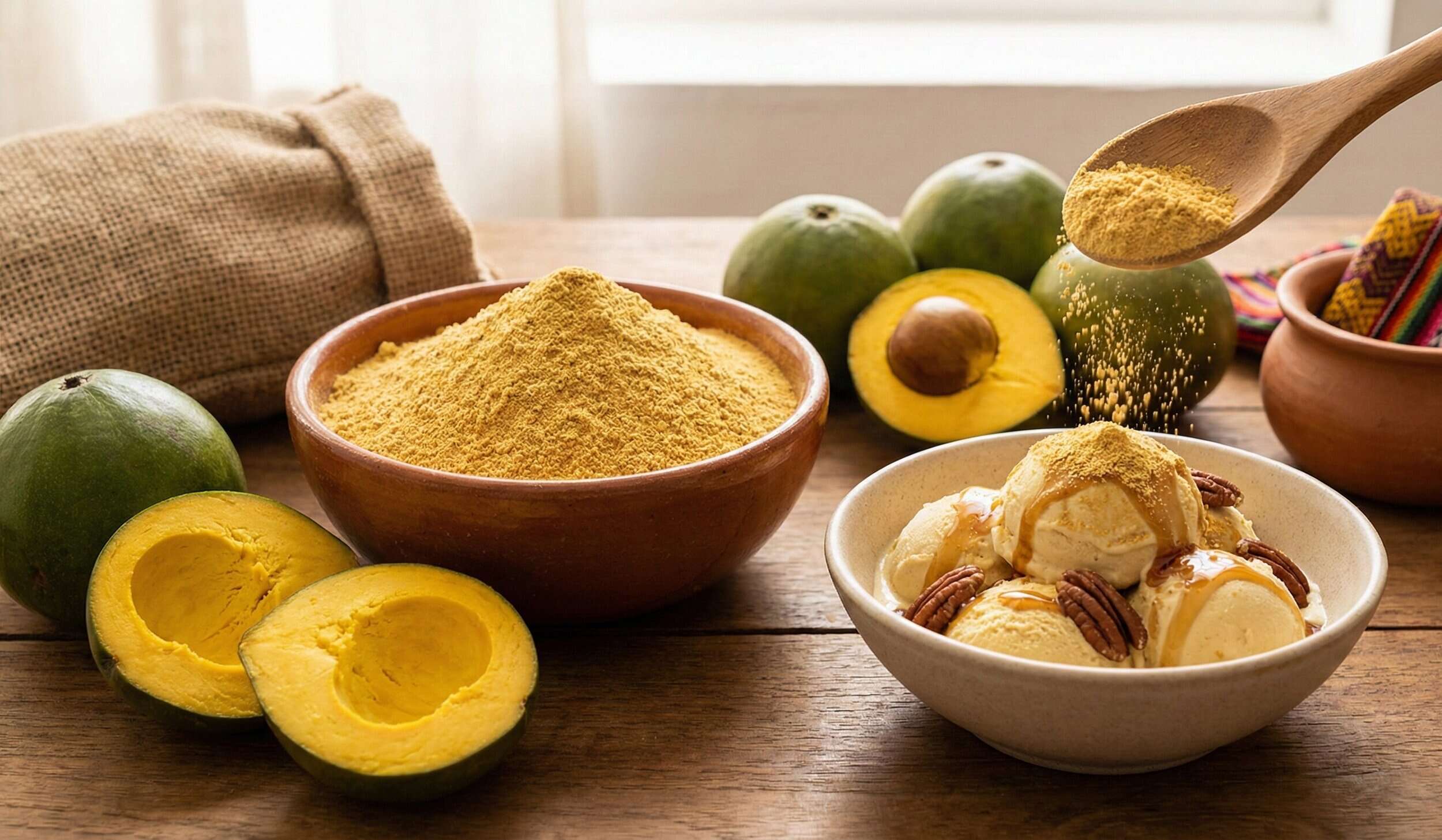
In its fresh form, Lucuma looks somewhat like a smooth-skinned avocado or a green mango. Inside, however, the flesh is dry, starchy, and bright yellow—resembling the texture of a hard-boiled egg yolk (which is why it is sometimes called “eggfruit” in English). Because the fresh fruit ferments rapidly and bruises easily, it is almost impossible to export fresh. This is where Lucuma Powder comes in. The fruit is harvested at peak ripeness, peeled, pitted, and dehydrated at low temperatures (below 45°C to maintain raw status) before being milled into a fine, flour-like powder. This process concentrates the flavor and shelf-life, turning a perishable fruit into a versatile dry ingredient for global manufacturers.
2. Sensory Profile: The “Maple-Cream” Experience
One of the greatest challenges in formulating with natural sweeteners is the “off-note” problem. Stevia has liquorice notes; Monk Fruit can be lingering; Yacon is molasses-heavy.
Lucuma is unique because its flavor profile is universally comforting.
The Taste Test
If you were to taste Impact Foods’ Organic Lucuma Powder straight from the spoon, you would experience:
- Primary Notes: Maple syrup, sweet potato, and brown sugar.
- Secondary Notes: Caramel, malt, and a hint of citrus zest.
- Mouthfeel: Creamy, velvety, and slightly starchy (similar to chestnut flour).
It is not an “intense” sweetener. It has a subtle sweetness (about 25% the sweetness of sugar). This means it is rarely used as a 1:1 replacement for sucrose if high sweetness is the goal. Instead, it is used to add body and complexity.
Flavor Pairing Synergy
For the formulator, Lucuma is a “bridge ingredient.” It connects flavors.
- Chocolate: It rounds out the bitterness of high-cocoa dark chocolate, adding a “milk chocolate” creaminess without the dairy.
- Coffee: It mimics the flavor of caramel syrup in latte blends.
- Vanilla: It enhances vanilla notes, making it more cost-effective by allowing you to reduce natural vanilla usage.
- Nut Butters: It pairs flawlessly with almond and cashew, creating a “cookie dough” flavor profile.
3. Technical Functionality: The Secret Emulsifier
This is the section most relevant to food technologists. Lucuma is not just for taste; it is a functional texturizer.
A. The “Fat Mimetic” in Ice Cream
In Peru, Lucuma is the most popular ice cream flavor—even beating vanilla and chocolate. But its role in ice cream goes beyond flavor. Lucuma powder contains significant amounts of insoluble fiber and starch. When hydrated, it swells and creates a creamy mouthfeel.
- For Vegan Ice Cream: One of the biggest complaints about plant-based frozen desserts is that they can be “icy” or “thin.” Adding Lucuma Powder helps mimic the creamy texture of dairy fat. It depresses the freezing point slightly and prevents large ice crystal formation, resulting in a scoopable, smooth product.
B. Emulsification Properties
While not a true emulsifier like lecithin, the starch structure of Lucuma helps stabilize emulsions in high-fat systems.
- Application: In vegan ganaches or nut-butter fillings, Lucuma helps prevent oil separation (syneresis), keeping the product shelf-stable and visually appealing.
C. Moisture Retention in Bakery
Lucuma is hygroscopic (it holds moisture).
- The Benefit: In Gluten-Free baking, products often dry out within 24 hours. Replacing 5-10% of the flour blend with Lucuma Powder can significantly extend the softness and freshness of muffins, cakes, and breads. It acts similarly to a sweet potato flour but with a more premium flavor profile.
4. Nutritional Biochemistry: The “Beta-Carotene” Bomb
In 2026, “Hidden Nutrition” is a major trend. Consumers want their indulgences to work harder for them. Lucuma allows you to turn a treat into a supplement.
The Color of Health
The striking ochre-yellow color of Lucuma Powder is not cosmetic; it is phytochemical.
- Beta-Carotene: Lucuma is packed with beta-carotene, a potent antioxidant that the body converts into Vitamin A. This supports eye health, immune function, and skin health (the “Beauty Food” angle).
- Natural Coloring Agent: By using Lucuma, manufacturers can ditch artificial yellow dyes (like Tartrazine) or expensive natural colors. A vanilla custard powder formulated with Lucuma naturally takes on a rich, “eggy” yellow hue—perfect for vegan custards where no eggs are present.
The Niacin (Vitamin B3) Connection
Unusually for a fruit, Lucuma is a good source of Niacin.
- Energy Metabolism: Niacin is essential for converting food into energy. This makes Lucuma an excellent addition to Sports Nutrition and Energy Bars, supporting the claim of “Sustained Energy” rather than just a sugar rush.
Mineral Density
- Iron & Zinc: Essential for plant-based diets where these minerals are often lacking.
- Potassium: Supports electrolyte balance.
5. The Glycemic Equation: Low GI for 2026
The “Glucose Revolution” is in full swing. Consumers are tracking their blood sugar responses using wearable tech. While Lucuma is rich in carbohydrates, it has a Low Glycemic Index (GI).
- The Mechanism: The carbohydrates in Lucuma are wrapped in complex fiber chains. This slows down digestion and absorption.
- The Result: Unlike cane sugar (GI ~65) or Maltodextrin (GI ~100+), Lucuma provides a slow, steady release of glucose into the bloodstream.
- Market Position: This makes it a safe ingredient for “Diabetic-Friendly” treats (in moderation) and the ideal sweetener for the Kids’ Snacking category, preventing the dreaded “hyperactivity spike” followed by the crash.
6. Market Applications: Innovation Opportunities
Where does Lucuma fit in your 2026 product pipeline? Here are the high-growth categories we are seeing at Impact Foods.
1. The “Clean” Baby Food Market
Parents are turning away from fruit concentrates (which are basically sugar syrups) in baby food.
- The Opportunity: Lucuma offers a mild, non-acidic flavor that babies love. It is gentle on the stomach and provides essential minerals for growth.
- Concept: “Oat & Lucuma Porridge Pot” or “Sweet Potato & Lucuma Teething Biscuits.”
2. Keto-Flex & Paleo Bakery
Strict Keto is niche, but “Keto-Flex” (Low Carb/High Fat) is mainstream.
- The Opportunity: Lucuma is not zero-carb, so it isn’t for strict keto. However, it is Paleo-approved. It is perfect for grain-free baking mixes (e.g., Almond Flour & Lucuma Pancakes) where it adds the browning capabilities that erythritol lacks.
3. Functional Lattes & “Moon Milks”
The beverage market is moving toward powdered “add-to-milk” blends.
- The Opportunity: “Golden Lucuma Latte.” Turmeric is earthy and can be bitter. Lucuma masks the bitterness of turmeric and adds body to the drink. It allows for a “No Added Sugar” claim if the natural sweetness of the Lucuma is sufficient.
4. Vegan White Chocolate
White chocolate is notoriously difficult to make vegan because it relies entirely on milk powder for flavor and texture.
- The Opportunity: Lucuma is the industry standard replacer for milk powder in vegan white chocolate. It provides the creamy color and the “milky” malted flavor note that cacao butter alone lacks.
7. Sourcing & Quality: The Impact Foods Standard
Not all Lucuma is created equal. As the “Gold of the Incas,” it is a high-value crop, which makes it susceptible to adulteration (cutting with potato starch or corn flour) in the general market.
The Impact Foods Promise:
- 100% Pure Pouteria Lucuma: We conduct rigorous microscopic and chemical testing to ensure no fillers or starches are added.
- Certified Organic: Sourced from certified organic cooperatives in the Peruvian Andes. This is crucial as conventional farming in the region can utilize pesticides that concentrate during the drying process.
- Low-Temp Processing: Our powder is “Raw” certified, meaning it has never been heated above 45°C. This preserves the delicate enzymes and the beta-carotene content. High-heat drying turns the powder brown and destroys the vitamin profile.
- Solubility (Mesh Size): We supply a fine-milled powder (typically 60-80 mesh) designed for rapid dispersion in liquids, ensuring no gritty texture in your beverages.
8. Formulation Guide: Dosage & Ratios
For our technical buyers, here are some starting points for R&D:
- In Smoothies: 1-2 tablespoons per serving adds thickness and creaminess.
- In Baking: Substitute up to 15% of the flour with Lucuma Powder. Reduce sugar in the recipe by 25%.
- In Ice Cream: Use 5-8% of the total mix weight for optimal texture and flavor.
- In Chocolate: Use up to 20% in vegan white chocolate formulations.
9. Regulatory & Labeling (UK/EU)
- Label Declaration: “Organic Lucuma Powder” or “Lucuma Fruit Powder.”
- Clean Label: No E-numbers. No “modified starches.”
- Claims: Depending on the dosage, products containing Lucuma can often claim “Source of Fibre,” “Source of Iron,” and “High in Antioxidants.”
10. Conclusion: The Sweet Spot of Innovation
The future of food is functional. It is no longer enough for a product to just taste good; it must do good.
Lucuma Powder is the rare ingredient that sits perfectly at the intersection of taste, texture, and health. It offers the caramel comfort consumers crave, the clean label manufacturers need, and the nutritional profile that modern science demands.
It is time to stop viewing Lucuma as an “exotic superfood” and start viewing it as an essential pantry staple for modern food manufacturing.
Ready to strike Gold?
Request a Wholesale Quote for Organic Lucuma Powder Order a Sample for Your R&D Team